

India Replaces Indonesia as Asia’s Most Unfavoured Stock Market
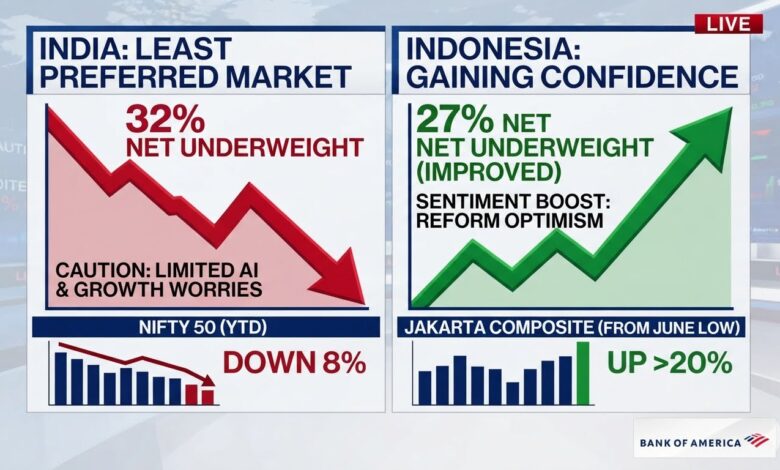
India has overtaken Indonesia as the least-preferred stock market in Asia, according to Bank of America’s latest survey of global fund managers, highlighting growing investor caution toward Indian equities.
The survey found that 32% of fund managers were net underweight on India, making it the weakest-ranked market in the region. Investors cited the country’s limited exposure to the artificial intelligence boom as their biggest concern, followed by worries over slower economic growth. High valuations and a lack of meaningful reforms were also identified as key risks.
Indonesia Gains Investor Confidence
Investor sentiment toward Indonesia improved during the month. The share of fund managers who were net underweight on Indonesian equities fell to 27% from 32% in July.
Meanwhile, Taiwan and Japan continued to be the most preferred markets among investors. The survey was conducted between August 7 and 13 and included 98 fund managers overseeing around $272 billion in assets.

Indian Stocks Under Pressure Despite Strong Earnings
The cautious outlook comes even as Indian companies have reported stronger earnings. Profits of companies in the benchmark Nifty 50 rose 18% year-on-year in the latest three-month period, exceeding expectations of around 10% growth from Motilal Oswal Financial Services.Global investors have also returned to Indian equities, purchasing more than $4 billion worth of local stocks during the current quarter, the highest inflow among regional emerging markets after heavy selling in the first half of the year.
Despite these positives, Indian stocks have remained under pressure. The Nifty 50 has fallen about 8% so far this year, making it the second-worst performing major stock market in Asia. The index is also at risk of ending its remarkable streak of 10 consecutive years of annual gains.

Rising Oil Prices Add to Investor Concerns
Higher energy prices are another source of pressure. Rising crude oil prices following geopolitical tensions have increased concerns over India’s growth and inflation outlook.
India was also ranked as the least-preferred market in the BofA survey in May. Investors had then been worried about the impact of higher energy costs on economic growth.
In contrast, Indonesia’s benchmark Jakarta Composite Index has gained more than 20% from its June low, helped by measures taken by the country’s central bank to stabilise the currency and reduced concerns about Indonesia being downgraded to frontier-market status by MSCI.
Overall, the survey indicates that while India’s corporate earnings and underlying fundamentals are showing improvement, global investors remain cautious because of valuations, growth concerns, reform expectations and the country’s relatively unclear exposure to the AI-driven investment cycle.