
Pradhan Questions Naveen Over MMDR Act

Former Union Minister and Sambalpur MP Dharmendra Pradhan has criticised BJD president Naveen Patnaik over the MMDR Amendment Act, 2026, accusing him of misleading people on the issue of bauxite pricing and mineral policy.
Pradhan’s remarks came after the Orissa High Court dismissed Vedanta’s plea seeking revival of a 2004 agreement concerning bauxite pricing and supply from the Odisha Mining Corporation (OMC).
In a post on X, Pradhan said the court’s order showed that earlier commitments relating to natural resources could not take precedence over existing laws. He alleged that the previous BJD government had sought to provide an advantage to a particular private company by seeking changes in the applicable pricing mechanism.
According to Pradhan, amendments introduced by the Narendra Modi government to the MMDR framework and Rule 45 of the Minerals (Other than Atomic and Hydro Carbons Energy Minerals) Concession Rules, 2016, resulted in a conversion factor being applied to the average sale price of bauxite. He said this increased the price from around ₹750 per tonne to ₹1,707 per tonne.
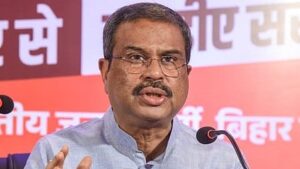
Pradhan claimed the revised pricing could have significantly increased OMC’s earnings as well as the state’s revenue through royalty, the District Mineral Foundation (DMF) and the National Mineral Exploration Trust (NMET).
He further alleged that Patnaik, who was Odisha’s chief minister at the time, wrote to the Centre on February 1 and October 7, 2020, seeking reconsideration of the conversion factor and a lower pricing mechanism. Pradhan said the Centre did not accept the request.
Questioning the rationale behind those communications, Pradhan also referred to alleged outstanding dues of around ₹5,400 crore from a private company. He sought an explanation from the former chief minister over what he described as decisions that could have affected Odisha’s mineral revenue and public interest.
The allegations are part of the ongoing political dispute between the BJP and BJD over the MMDR Amendment Act and the state’s mineral resources.