

Odisha Flood Situation Under Control, Over 1 Lakh Affected; 79 Rescue Teams Deployed
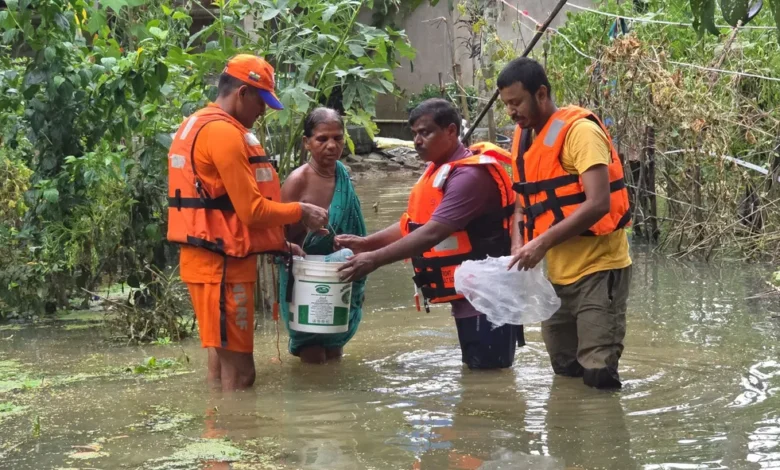
Bhubaneswar: The flood situation in Odisha remained under control on Tuesday despite heavy rainfall triggered by a low-pressure system, even as more than one lakh people have been affected across Bhadrak, Jajpur and Kendrapada districts.
The state government has stepped up its preparedness, deploying 79 rescue teams to vulnerable and affected areas. The Special Relief Commissioner (SRC) office and State Emergency Operation Centre (SEOC) are keeping a close watch on the situation and coordinating rescue and relief measures around the clock.
According to the India Meteorological Department (IMD), the low-pressure area over Gangetic West Bengal, adjoining Jharkhand and north Odisha continues to persist over the region. An associated cyclonic circulation extends up to around 7.6 km above mean sea level.
The weather system is expected to move nearly northwestwards across Jharkhand and north Odisha during the next 24 hours, the IMD said.
Several districts have been warned of thunderstorms, lightning and gusty winds of 30–40 kmph. Authorities in Baleshwar, Bhadrak, Jajpur, Kendrapada, Jagatsinghpur, Cuttack, Sundargarh, Jharsuguda, Bargarh, Sambalpur, Keonjhar, Mayurbhanj, Gajapati, Ganjam, Puri, Khordha and Nayagarh have been directed to remain vigilant.
Flood Impact
Bhadrak has reported the highest number of affected people, with 75,432 residents across 70 villages under 18 Gram Panchayats in Tihidi and Chandabali blocks impacted by flooding.
In Jajpur, 21,010 people from 41 villages under 15 Gram Panchayats in Bari, Binjharpur and Dasarathpur blocks have been affected. The district administration has opened 67 relief camps.
Kendrapada has reported 5,475 affected people across five blocks, one urban local body, 11 wards, 35 Gram Panchayats and 64 villages. Thirteen relief camps are currently functioning there.
Heavy rainfall has also caused disruptions in parts of Keonjhar, Nabarangpur and Koraput. In Nabarangpur, nine blocks have been affected, prompting the evacuation of 1,622 people to relief camps. Another 660 people have been shifted to safer locations in Koraput.
79 Rescue Teams on Standby
To strengthen emergency response, the state has mobilised 79 rescue teams, comprising 28 ODRAF teams, one NDRF team and 50 Fire Services and Emergency Services teams.
The teams have been positioned to respond quickly to flooding, waterlogging and other emergencies should conditions worsen.
Odisha recorded an average rainfall of 17.5 mm over the past 24 hours. Barkot block in Debagarh district recorded the highest rainfall at 162.2 mm.
Four blocks received more than 100 mm of rain, while nine blocks and one urban local body recorded rainfall between 50 mm and 100 mm.
Odisha Records Rainfall Surplus
The state has experienced above-normal rainfall this month. Between August 1 and August 25, Odisha received 344.4 mm of rain against the normal 287.1 mm, marking a 20 per cent surplus.
Since the onset of the monsoon season on June 1, the state has recorded 1,100.6 mm of rainfall against the normal 831.5 mm, which is 32.4 per cent above normal.
The state government has released Rs 170.30 crore from the State Disaster Response Fund (SDRF) in phases to support relief camps and emergency response operations in flood-affected areas.
Authorities have also supplied 1,35,725 polythene packets and 1,587.56 metric tonnes of cattle feed to the affected districts.
District administrations have been instructed to closely monitor low-lying areas, waterlogging, roads, underpasses and vulnerable structures. Officials have also been asked to remain prepared for damage to kutcha roads and other infrastructure.
Residents have been advised to move to safer locations during thunderstorms and lightning and to follow official weather updates.
The SEOC continues to coordinate with District Emergency Operation Centres (DEOCs) across the state. Officials said the overall flood situation remains under control, although vulnerable districts continue to be monitored closely.