

Centre Raises MSP for 14 Kharif Crops for 2026–27
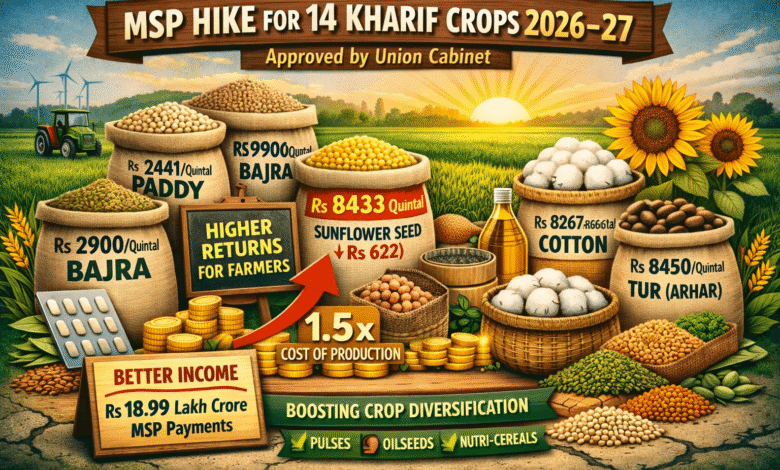
The Union Cabinet Committee on Economic Affairs, chaired by Prime Minister Narendra Modi, approved a hike in the Minimum Support Prices (MSP) for 14 kharif crops for the 2026–27 marketing season.
The decision aims to ensure better returns for farmers and promote crop diversification across India.
Sunflower seed received the highest absolute MSP increase of Rs 622 per quintal, followed by cotton, nigerseed, and sesamum. The revised MSP structure aligns with the government’s 2018–19 commitment to fix MSP at least 1.5 times the all-India weighted average cost of production.
Among cereals, paddy (common) will fetch Rs 2,441 per quintal and grade A Rs 2,461. Bajra stands at Rs 2,900, maize at Rs 2,410, jowar (hybrid) at Rs 4,023, and ragi at Rs 5,205. In pulses, tur/arhar is priced at Rs 8,450, moong at Rs 8,780, and urad at Rs 8,200 per quintal. Oilseeds include groundnut at Rs 7,517, sunflower seed at Rs 8,343, soybean (yellow) at Rs 5,708, sesamum at Rs 10,346, and nigerseed at Rs 10,052. Cotton MSPs are Rs 8,267 for medium staple and Rs 8,667 for long staple.
The government estimates farmers will earn at least 50% profit over production costs, with moong offering the highest return at 61%. The MSP policy supports pulses, oilseeds, and nutri-cereals to reduce import dependence and strengthen farm incomes.
Procurement data shows paddy purchases rose to 8,418 lakh metric tonnes between 2014–15 and 2025–26, with total MSP payments across 14 kharif crops reaching Rs 18.99 lakh crore.