
Snana Jatra: Sacred Bathing Ritual Marks Lord Jagannath’s Appearance Day
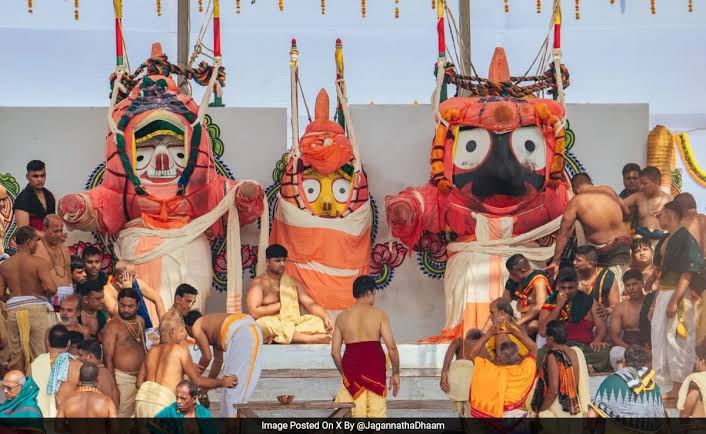
Puri: As the sacred month of Jyestha reaches its full moon day, the temple town of Puri gears up for one of the most spiritually significant events on its calendar — Snana Jatra or Deba Snana Purnima, the ceremonial public bathing of the holy triad: Lord Jagannath, Lord Balabhadra, and Devi Subhadra.
Held ahead of the grand Rath Yatra (Car Festival), this elaborate ritual is far more than a symbolic purification ceremony. Rooted deeply in ancient scriptures and cultural practices, the Snana Jatra marks the appearance day of Lord Jagannath and is steeped in spiritual, ritualistic, and even agrarian significance.

Ancient Origins and Scriptural References
The ceremonial bath is described in sacred texts like the Skanda Purana, which credits King Indradyumna, the legendary installer of the wooden deities, with initiating this sacred observance. The ‘Niladri Mohadaya’, a traditional Odia religious scripture, outlines the intricate details of the Snana rituals, while the ‘Naisadhiya Charita’ by poet Sriharsa also makes early references to this tradition.
The deities are bathed with 108 vessels of sacred water, drawn ceremoniously from the Suna Kua (Golden Well) near the Sitala temple inside the Jagannath temple premises. Priests, with their mouths covered to avoid contaminating the water, carry it to the Bhoga Mandap, where it is infused with turmeric, rice, sandalwood, fragrant oils, herbs, and flowers before being used for the Jaladhibasa (ritual bath).

Rituals that Echo with Cultural Symbolism
On Chaturdashi, the day before Snana Purnima, the deities are brought out in a grand Pahandi Vijay procession from the sanctum to the Snana Mandap, a raised bathing platform that allows devotees outside the temple to have darshan. This journey is accompanied by drum beats, kirtan, and music — a spectacle witnessed by thousands.
Post bathing, the deities are dressed in the Gajanana or Hati Vesha, an elephant attire resembling Lord Ganesh. This tradition is rooted in a captivating legend. It is said a devout scholar and worshipper of Lord Ganesh once refused to have darshan of Lord Jagannath. Moved by devotion, Lord Jagannath manifested in elephant form, resembling Ganesh — a gesture to welcome all faiths into His fold.
The deities remain in this unique attire until the evening, when the Snana Jatra concludes. The extensive bathing often fades the natural mineral paints on the wooden idols, rendering their features faint. This leads to the Anasara period — a 15-day phase when the deities withdraw from public view, symbolically falling ill and undergoing recovery.
Anasara: A Time of Renewal and Devotion
During this time, the deities are kept in a secluded chamber called the Ratan Vedi, attended by the Daitas, descendants of tribal worshipper Viswavasu. The idols are carefully repainted and restored, using traditional colours and techniques, in preparation for their next grand appearance.
This secluded period culminates on the 16th day with Naba Joubana Darshan or Netrotsav, the “Festival of the Eyes,” when the rejuvenated deities make their much-awaited return for public darshan. According to temple priests, witnessing Lord Jagannath on this day is believed to wash away all sins.
Even during Anasara, devotion doesn’t pause. Offerings of fruits, herbal preparations, and Dasamula medicines are made, symbolizing divine recuperation under the care of the Raj Vaidya (royal physician).
Agrarian Ties and Global Observance
Beyond its religious significance, Snana Jatra is also believed to be tied to Odisha’s agrarian calendar, symbolising the onset of monsoon. Similar to Seetal Sasthi, observed in western Odisha, this ritual is believed to invoke rain and ensure a bountiful agricultural season.
While the Puri Snana Jatra is celebrated on a grand scale, similar versions take place across Odisha and now even globally — a testament to Lord Jagannath’s ever-expanding circle of devotees.
As preparations begin for the Rath Yatra, the Snana Jatra not only marks a sacred beginning but also reminds devotees of the Lord’s intimate connection to human emotions, nature’s rhythms, and the enduring cycle of devotion, decay, and renewal.