

DRDO Successfully Conducts Maiden Flight-Test of Indigenous Kusha Air Defence Missile from Odisha
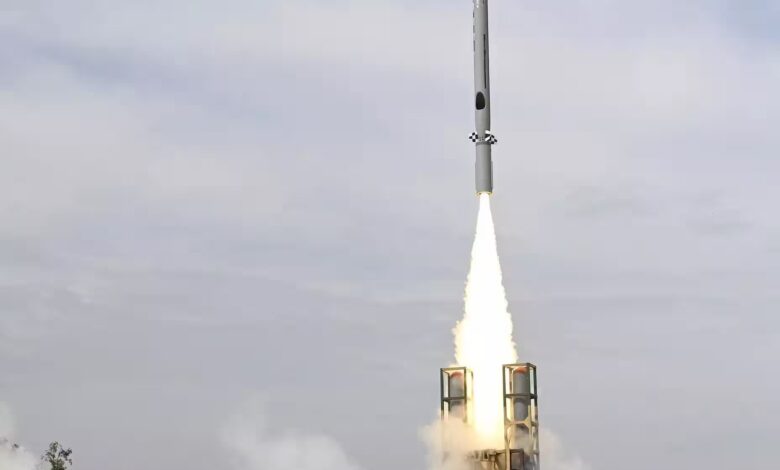
Bhubaneswar: India achieved a major breakthrough in strengthening its indigenous air defence capabilities on Thursday as the Defence Research and Development Organisation (DRDO) successfully carried out the first flight-test of the Kusha Long-Range Surface-to-Air Missile (LRSAM) from the Integrated Test Range at APJ Abdul Kalam Island off the Odisha coast.
The trial involved an electronic target designed to replicate a fast-moving, high-altitude aerial threat. According to the Ministry of Defence, the missile accurately tracked, intercepted and destroyed the target, successfully validating the performance of the newly developed air defence system.
Developed entirely within the country, the Kusha missile system is capable of engaging multiple types of airborne threats, including fighter jets, cruise missiles, unmanned aerial vehicles (UAVs) and large aircraft over long distances and at varying altitudes. The system comprises an advanced missile, radar network, command-and-control infrastructure and associated launch components, all designed by DRDO laboratories with support from Indian industry.
Defence Minister Rajnath Singh hailed the successful maiden flight-test as a landmark achievement for India’s defence research ecosystem. Congratulating the DRDO scientists and industry partners, he said the development reflects the country’s growing expertise in advanced long-range missile technology—an area mastered by only a few nations worldwide. He also noted that the indigenous system would reduce dependence on foreign defence equipment while significantly enhancing India’s air defence preparedness.
Defence Secretary and Secretary, Department of Defence R&D, Rajesh Kumar Singh, who oversaw the launch activities, also extended his congratulations to the scientists, engineers and technical teams involved in the project.
The successful trial is being viewed as a significant boost to India’s self-reliance in defence manufacturing and an important addition to the country’s evolving multi-layered air defence network, reinforcing its ability to counter emerging aerial threats with home-grown technology.