
NIT Rourkela Develops Urine-Based Fertiliser Recovery Technology
Researchers at the National Institute of Technology (NIT) Rourkela have developed an innovative technology that can extract valuable fertiliser material from human urine, offering a promising approach to waste management and sustainable agriculture.
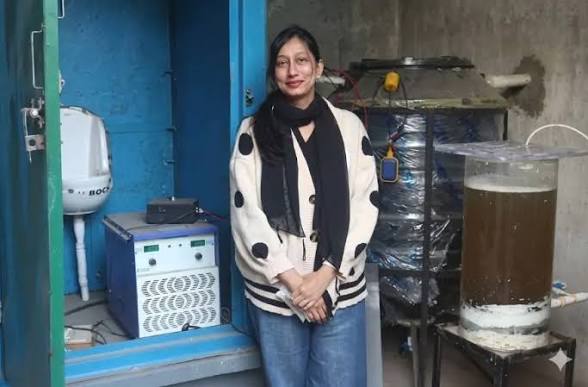
The newly developed electrochemical technique enables the recovery of struvite, a phosphate-rich mineral commonly used as a slow-release fertiliser. The process uses magnesium electrodes and electricity to convert nutrients present in urine into solid fertiliser, without requiring additional chemicals.
The research team includes Associate Professors P Balasubramanian and Sivaraman J, Assistant Professor Bikash Chandra Maharaj, and research scholar Alisha Zaffar from the Department of Biotechnology and Medical Engineering. Their findings have been published in the Journal of Water Process Engineering.
Phosphorus, an essential component of NPK fertilisers, plays a crucial role in plant development and maintaining soil fertility. However, conventional fertiliser production involves considerable energy consumption and high costs.
Existing urine-based nutrient recovery methods generally depend on chemical precipitation, requiring regular supplies of alkaline substances and magnesium salts. NIT Rourkela’s approach seeks to overcome this limitation by generating magnesium ions directly through the gradual dissolution of magnesium electrodes when electricity passes through the urine.
These magnesium ions combine with naturally available substances in the urine to produce struvite, reducing dependence on externally supplied chemicals.
The researchers have also identified electrode sludge accumulation as a major technical challenge, as it can interfere with electrical conductivity and lower the system’s efficiency.
According to Prof. P Balasubramanian, the technology provides a sustainable alternative for recovering nutrients while reducing chemical consumption. Its compact and modular design could make it suitable for decentralised applications, opening new possibilities for converting human waste into useful agricultural resources.