

AI Breakthrough at NIT Rourkela Promises Faster Detection of Food Adulteration
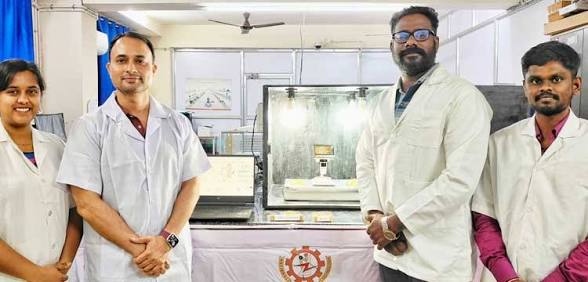
Rourkela: In a significant step towards improving food safety, researchers from National Institute of Technology Rourkela have designed a new artificial intelligence-driven system that can quickly detect and measure adulteration in spices and other food items.
The innovation uses a combination of Fourier Transform Infrared Spectroscopy and machine learning to analyse food samples in real time. Unlike traditional lab-based methods that can take hours or even days, this system delivers results within seconds, making it highly suitable for routine checks in industries and regulatory bodies.

Food adulteration continues to be a widespread issue across India, often posing serious health risks while also affecting consumer trust. Existing testing methods, though reliable, require specialised equipment, trained manpower, and significant processing time. The newly developed system aims to overcome these limitations by offering a quicker, non-destructive, and cost-efficient alternative.
The technology works by capturing the infrared signature of a sample and processing it through trained algorithms to identify irregularities. What sets this system apart is its ability not only to detect adulterants but also to estimate their quantity—something conventional techniques struggle to achieve efficiently.
During testing, the system showed an accuracy of around 92 per cent in identifying adulteration in coriander powder, including the detection of substances like sawdust. Researchers say the model can be further trained to detect different types of contaminants across a wide range of food products.
The findings of the study have been published in the journal Food Chemistry. The research was carried out by Prof. Sushil Kumar Singh, along with the late Prof. Poonam Singha and M.Tech scholar Rishabh Goyal from the institute’s Department of Food Process Engineering.
The team has also secured a patent for the technology, highlighting its potential for real-world application. According to the researchers, the system can be easily integrated into existing quality control setups without major changes, making it practical for both large industries and small businesses.
Looking ahead, the researchers plan to partner with industry players to test the system in real operational conditions and expand its use across more food categories.
With rising awareness around food quality and safety, such AI-based solutions could play a key role in strengthening monitoring systems and ensuring safer consumption for the public.