

Permanent Enemy; Now Friend….
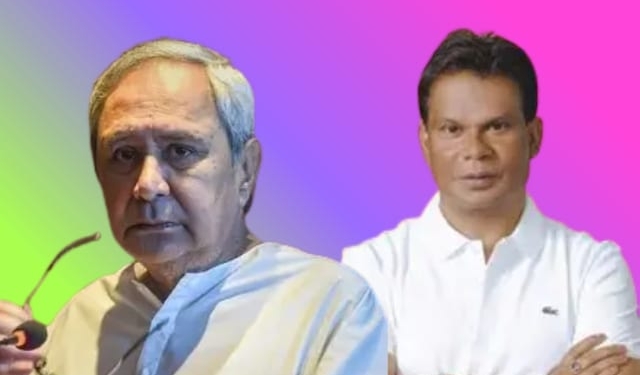
Bhubaneswar: Odisha’s political landscape is witnessing a dramatic déjà vu as the 2002 Rajya Sabha election scenario appears to replay itself in 2026. The rivalry between former Chief Minister Naveen Patnaik and industrialist-turned-politician Dilip Ray is once again at the forefront, with Ray contesting as an independent candidate backed by the BJP, challenging Patnaik’s Biju Janata Dal (BJD) in a high-stakes battle for four Rajya Sabha seats.
In 2002, the election for four seats saw five candidates in the fray, including four party nominees and Ray as an independent. The contest was perceived as a direct showdown between then-Chief Minister Naveen Patnaik and Ray, who had been ousted from the BJD and removed from his central ministerial post. Despite heavy surveillance and government efforts to block him, Ray managed to file his nomination inside the assembly and secure victory through cross-voting, garnering support from 14 BJD MLAs. BJD candidates Sushree Devi and Pramila Bahidar won, along with BJP’s Surendra Lath, while Congress’s Moris Kujur lost, paving the way for Ray’s independent triumph.
Fast forward 24 years, and the parallels are striking. Once again, five candidates are competing for four seats. Ray, now supported by the BJP, has filed as an independent, directly opposing BJD’s nominees. Patnaik, now the Leader of Opposition, had previously clashed with Ray, and the current setup echoes that tension. In 2002, 143 MLAs voted, with a first-preference quota of 29 votes needed for victory. Ray secured 22 first-preference votes and 6 second-preference ones, edging out Kujur, who got 23 but no seconds. BJD’s Sushree Devi won with 26 firsts and 3 seconds, Pramila Bahidar with 32 firsts, and BJP’s Lath with 39 firsts. Cross-voting was rampant, with Congress losing two votes and the BJP missing two despite 41 MLAs.
Notably, CPM’s Pradipta Panda and Secular Janata Dal’s Ashok Das abstained, while School and Mass Education Minister Bhagabat Behera couldn’t vote due to illness. One vote was invalid out of 147 possible.
Future History Will Tell…
Questions swirl around BJD’s future alliances: Will it align with Congress? Shift its equidistance policy? Join anti-BJP forces nationally? Patnaik’s decision to field joint candidates with Congress and CPM support has fueled speculation. When asked about a potential BJD-Congress tie-up, Patnaik said, “Time will tell.” He reaffirmed his secular stance, repeating his 2014 statement that his “flesh and bones are secular.”
Naveen-Bhakta and Suresh’s Firm Stance: Common Candidate Will Win
LoP Naveen Patnaik expressed confidence that BJD’s Dr Santrupt Mishra and the common candidate Dr Datteswar Hota will secure victory. “I congratulate both and am certain of their resounding win,” he said.
PCC President Bhakta Charan Das hailed the alliance as a historic equation, emphasising unity. “Congress is fully united; AICC approved Patnaik’s proposal. All our MLAs will vote together without issues. The common candidate’s win is assured.”
CPM State General Secretary Suresh Chandra Panigrahi asserted, “2002 won’t repeat in 2026. The picture will be different. The joint candidate will definitely win, based on principles, decisions, and ideals.”
2002-Like Support Will Ensure My Victory: Dilip
Dilip Ray, exuding confidence, vowed to replicate his 2002 strategy. After filing nomination, he thanked BJP for support, naming PM Narendra Modi, Home Minister Amit Shah, national president Nitin Nabin, CM Mohan Charan Majhi, and state BJP president Manmohan Samal.
“My campaign starts tomorrow. I have full faith that, just like in 2002, I’ll get complete support and win,” Ray said. Known as a shrewd political player, Ray’s career spans from industrialist to Rourkela NAC chairman in 1985, MLA wins in 1985 and 1990, state Industry Minister under Biju Patnaik, Rajya Sabha in 1996, central minister under HD Deve Gowda and Atal Bihari Vajpayee. Ousted from BJD in 2002, he won independently. Joining the BJP in 2014, he became MLA again but faced a coal scam conviction in 2020 (stayed by the Delhi HC in 2024).
Despite BJP’s 22 MLAs, Ray needs 8 more first-preference votes to hit the 30-quota mark, likely from cross-voting in Congress or BJD—mirroring his 2002 success.