
Huawei Watch GT 6 and GT 6 Pro with bigger batteries
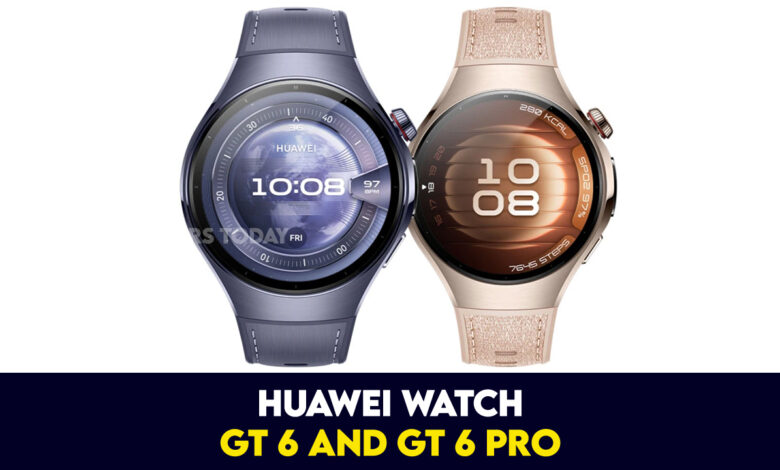
A year later, almost to the day, Huawei unveils its new Watch GT 6 series. The latest smartwatches improve battery life and positioning accuracy, while the updated software offers new and improved sports modes and health tracking features.
There are two models – the Huawei Watch GT 6, coming in 41mm and 46mm, and the Huawei Watch GT 6 Pro, which only comes in 46mm size now (the GT 5 Pro had a 42mm variant).
Let’s start with the battery – the 46mm Pro model can last up to 21 days with light usage or up to 12 days with typical usage. The small 41mm GT 6 model can do up to 14 days of light usage and up to 7 days of typical usage.
Huawei achieved this with the first “high-silicon stacked custom-shaped batteries.” That’s a lot of words, but the GT 6 batteries use 10% more silicon and are a complex shape (instead of the usual rectangle) to better conform to the shape of the watch. This improves space utilization and boosts energy density by 37%.
The other big hardware upgrade is the new antenna design and positioning algorithms, which promise 20% better positioning accuracy with dual-band support for all positioning systems.
There are many other improvements this generation too. The 46mm models have a 1.47” OLED display, which is 5.5% larger than the old 1.43” display. Even better, the display can achieve 3,000 nits peak brightness – that’s more than double what the GT 5 Pro could do (1,200 nits peak). The 41mm GT 6 has a smaller but still fairly large 1.32” OLED display. For comparison, a Galaxy Watch8 Classic (46mm) has a 1.32” display.
Huawei also revamped its TruSense sensor and algorithm suite. Cycling and trail runs are a major focus this generation (more on them in a bit) and heart rate accuracy is up to 98% for cycling and up to 95% for trail running (the watch bouncing on your wrist makes measurements quite difficult).
The Huawei Watch GT 6 models can connect to a variety of third-party sensors: heart rate straps, cadence sensors, power meters and speedometers. If you use a power meter for cycling, the watch can show you your Functional Threshold Power – the power level you can sustain for an hour without fatigue. There are additional cycling metrics enabled by the improved positioning system – the watch can show real-time gradient, average gradient and gradient range stats.
Interestingly, Huawei developed a virtual power meter, a first for a smartwatch. This shows you real-time and average power while cycling, even if you don’t own a power meter. Another cool feature is trackable group rides – you can join a group of cyclists and see real-time location and status for all of them.