
DRDO Successfully Conducts High-Speed Ejection System Test
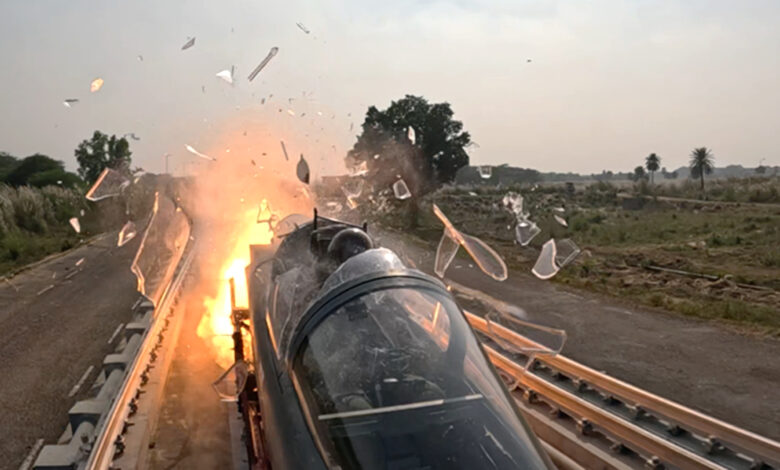
New Delhi: The Defence Research and Development Organisation (DRDO) has successfully carried out a high-speed rocket-sled test of a fighter aircraft escape system at controlled velocity, marking a significant step in India’s indigenous defence capabilities.
The dynamic ejection trial was conducted at the Rail Track Rocket Sled (RTRS) facility of DRDO’s Terminal Ballistics Research Laboratory in Chandigarh. The test validated key parameters including canopy severance, ejection sequencing and complete aircrew recovery.

The trial was executed in collaboration with the Aeronautical Development Agency (ADA) and Hindustan Aeronautics Limited (HAL). With this achievement, India joins a select group of nations equipped with advanced in-house testing systems for aircraft escape mechanisms.
Dynamic ejection trials—much more complex than static tests like Net Tests or Zero-Zero Tests—serve as the ultimate indicator of ejection seat performance. For the test, a dual-sled system fitted with the Light Combat Aircraft (LCA) forebody was propelled to a precisely controlled speed using multiple solid-propellant rocket motors fired in phases.
An instrumented Anthropomorphic Test Dummy simulated real-time pilot conditions, capturing data on acceleration, load and moments during the ejection sequence. The entire process was documented through onboard and ground-based imaging systems.
Officials from the Indian Air Force (IAF) and the Institute of Aerospace Medicine witnessed the test.
Defence Minister Rajnath Singh congratulated DRDO, IAF, ADA, HAL and industry partners, calling the accomplishment a major stride in strengthening India’s self-reliance in defence technology.
DRDO Chairman and Defence R&D Secretary Dr. Samir V. Kamat also lauded the teams involved in the successful demonstration.